

Benefits of Supporting Local Artisan Communities
Table of Contents
- Why Supporting Local Artisan Communities Matters for Your Home
- The Benefits of Buying Local: Craft, Character and Connection
- How Supporting Local Artisans Preserves Traditional Skills
- Sustainable Furniture: Why Artisan Pieces Outlast Fast Buys
- How to Buy Handmade Furniture With Confidence
- Bringing Artisan Craft Into a Modern Home
- Frequently Asked Questions
Last Updated: October 12, 2026
Why Supporting Local Artisan Communities Matters for Your Home
The benefits of supporting local artisan communities reach far beyond the object you carry through your front door. Every hand-thrown bowl, hand-carved chair and mouthblown vase carries the fingerprints, decisions and skills of a real maker, and choosing those pieces over mass-produced alternatives changes what your home feels like to live in.
This guide from Extraordinary Emporium explores why those choices matter, what they give back to craft traditions, and how to buy handmade furniture with confidence.
There is a quiet difference between a room filled with flat-pack and a room where every piece has a story. One is furnished. The other is composed. That distinction sits at the heart of everything we curate.
Below, we break down the practical benefits, from money staying in local hands to pieces that outlast three replacements, plus the questions to ask before you order.
The Benefits of Buying Local: Craft, Character and Connection
Buying local means your money supports a named maker rather than an anonymous production line. The benefits of buying local show up in three places: the community that keeps its skills, the home that gains character, and the buyer who ends up with something genuinely one of a kind.
Keeping Money and Skills in the Community
When you buy from an artisan workshop, the money circulates close to where the work was made. Wages go to craftspeople, materials come from nearby suppliers, and the skills involved get passed to the next generation instead of fading out. A workshop that stays busy is a workshop that can take on an apprentice.
That is the practical side of supporting local artisan communities. It is not abstract. It is rent paid, tools sharpened, and a trade kept alive.
Pieces With a Story You Can Trace
Mass-produced furniture arrives with a barcode. An artisan piece arrives with a maker, a method and often a region. A hand-carved chair in solid mango wood, for instance, carries the marks of the person who shaped it, and those small variations are the point rather than a flaw.
What most guides miss is that traceability changes how you live with a piece. You repair it rather than replace it. You notice the grain. It becomes part of the room's identity instead of background furniture.
How Supporting Local Artisans Preserves Traditional Skills
Traditional skills survive only when someone is paying for them. Hand-carving, mouthblown glass, hand-weaving and hand-thrown ceramics are all learned over years, and every commission keeps that knowledge in active use rather than in a museum case.
Consider mouthblown glass. Each vessel is shaped by a master glassblower working in the traditional way, and small deviations such as air bubbles or slight variations in colour are not defects but evidence of the process. No two pieces come out exactly alike, and that is precisely what makes them worth owning.
The same logic applies to ceramics. A hand-thrown stoneware plate carries the slight unevenness of a human hand, and a hand-carved wooden sculpture shows the tool marks of its maker. Supporting local artisan communities means those techniques keep being practised, taught and refined. Stop buying, and the skills go quiet within a generation.

Sustainable Furniture: Why Artisan Pieces Outlast Fast Buys
Sustainable furniture is furniture you only buy once. That is the simplest definition, and it reframes the whole decision. The greenest chair is not the one with the best eco label; it is the one still in your living room in fifteen years.
Fast furniture is cheap because it is built to a price, often from particleboard and veneer, and it tends to fail at the joints. Artisan pieces are typically built from solid wood, hand-joined and finished to be repaired rather than discarded. A solid mango wood frame or a burl wood table can be re-oiled, re-upholstered and handed on.
Large Saltwater Lavender Handmade Ceramic Stoneware Dinner Bowl →
Materials and Making Methods That Reduce Waste
Handmaking is inherently lower-waste than mass production. A craftsperson cuts to the piece in front of them, works with the grain, and uses offcuts for smaller items. There is no overproduction sitting in a warehouse waiting to be discounted or binned.
Natural materials also age better. Solid wood, linen, cotton, leather and stoneware all develop character with use rather than degrading into landfill. A beeswax food wrap is a small example of the same principle: biodegradable, reusable, and nothing sent to landfill.
Approach |
Typical Lifespan |
Repair Options |
End of Life |
|---|---|---|---|
Fast furniture |
A few years |
Limited, often glued joints |
Usually landfill |
Artisan solid wood |
Decades |
Re-oiling, re-upholstery, re-joining |
Repairable, resellable |
Handmade ceramics |
Decades with care |
Dishwasher safe, chip-resistant glaze |
Long service life |
Mouthblown glass |
Decades |
Handled with care |
Kept, not replaced |
That table is the argument in miniature. The cheaper piece costs less once. The artisan piece costs less across its life.
How to Buy Handmade Furniture With Confidence
Buying handmade online comes down to asking the right questions before you order. A legitimate maker will answer all of them without hesitation, and the answers tell you more than any product photo.
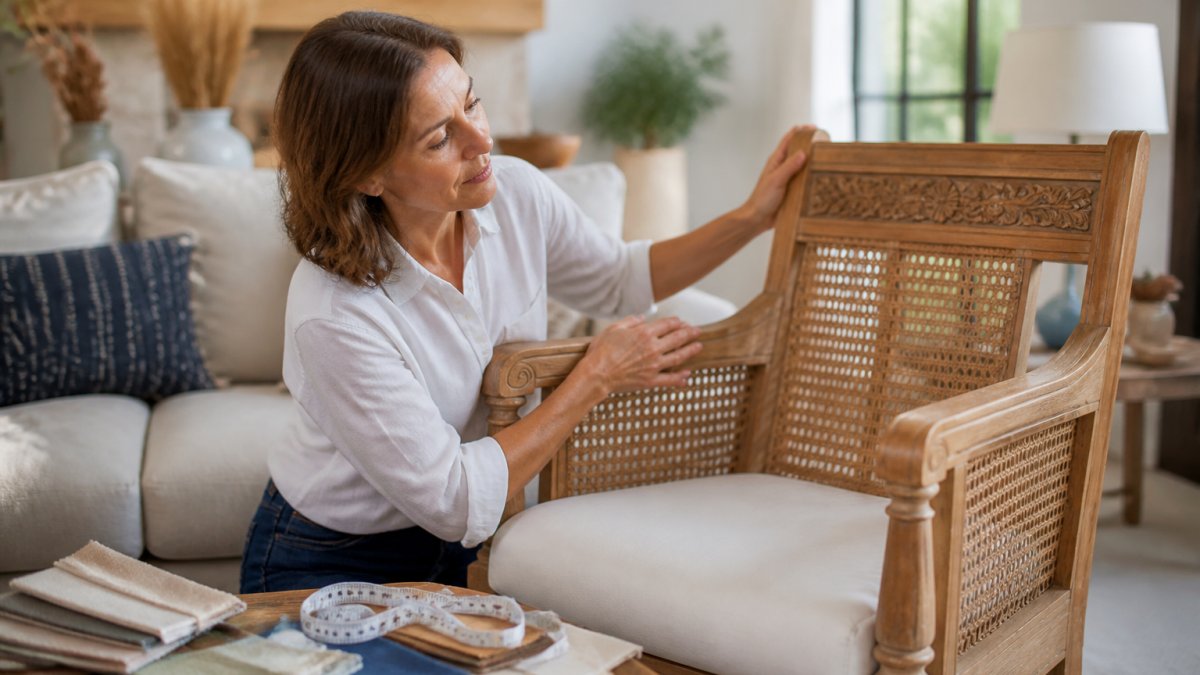
Examining the hand-carved detail on a wooden armchair
Things to Check
- Where did the piece come from?
- What are the exact dimensions, in centimetres?
- What material is the frame or body made from?
- How is it finished, and how do I care for it?
- What is the realistic lead time for a made-to-order piece?
- What is the returns policy if it does not suit the space?
Lead times matter most on made-to-order work. A hand-carved chair can carry a production cycle of several weeks from order to delivery, and that is normal for genuine handwork rather than a warning sign. Plan around it if you are mid-renovation.The most common mistake is ordering a made-to-order piece without checking the lead time against your project schedule. Measure the space first, then confirm the timeline in writing before you commit.
Bringing Artisan Craft Into a Modern Home
Artisan pieces do not require a rustic interior. A hand-thrown stoneware plate in a soft, muted glaze sits comfortably on a contemporary table, and a sculptural burl wood coffee table works in a minimalist room precisely because its grain provides the only pattern the space needs.
The trick is restraint. Choose two or three artisan pieces per room and let them carry the character, rather than filling every surface. A single mouthblown vase on a console, a handwoven armchair by a window, a carved sculpture on a shelf: each becomes a focal point rather than clutter.
This is where a curated approach beats browsing endless listings. At Extraordinary Emporium, every piece is selected for how it sits alongside the others, so a room comes together as a considered whole. Our Mota Wooden Round Coffee Table is a good example: each one is unique because the burl grain is never repeated, so it anchors a living space.
For smaller budgets, the entry point does not have to be a statement piece. A Vase SOLIFLEUR Budvase at £19.95 brings the same handmade character to a bedside table or windowsill, and a set of handmade beeswax wraps at £14.99 carries the same principle into the kitchen. Supporting local artisan communities does not require a large spend; it requires a deliberate one.
Frequently Asked Questions
What are the benefits of supporting local artisans?
Supporting local artisans keeps money circulating in the community, preserves handcraft skills that would otherwise fade, and gives you pieces made with real care rather than factory shortcuts. You also get furniture and homeware with genuine character, since no two handmade items are identical. Many artisan makers work with sustainable materials and small production runs, so your purchase supports responsible making as well as local livelihoods.
Is artisan-made furniture more sustainable than mass-produced furniture?
Often, yes. Artisan makers typically produce in small batches, use solid materials such as stoneware clay, mango wood and natural linen, and build pieces to be repaired rather than replaced. A hand-carved chair or a stoneware dinner plate is made to last years of daily use, which reduces the cycle of buying and binning that defines fast furniture. Fewer units made and fewer replacements needed means less waste overall.
How can I tell whether furniture is genuinely handmade?
Look for small variations between pieces, visible tool marks or hand-finished edges, and details about the maker. Genuine handmade items, such as mouth-blown glass vases or hand-carved mango wood sculptures, carry slight differences in colour, shape and texture that machines cannot replicate. Ask who made the piece and where, and check whether the maker or studio is named. If the listing cannot tell you who made it, treat the 'handmade' claim with caution.
Why does handmade furniture cost more than mass-produced pieces?
A handmade piece carries the hours of a skilled maker, not a production line. Hand-carving, hand-weaving and mouth-blowing glass take time that machines do not, and the materials are usually solid rather than veneered or composite. That higher cost buys durability, a unique finish and a piece that can often be repaired rather than replaced. Spread over the years you will own it, the cost per year is often lower than replacing cheaper furniture repeatedly.
The challenge is that most furniture on the market is built to be replaced, not kept, which is why so many rooms end up feeling anonymous. Extraordinary Emporium exists to change that, with artisan handcrafted furniture that is ethically sourced and sustainably made, a curated selection designed for conscious homes, and pieces that bring personality and purpose to every living space. Get started with Extraordinary Emporium and view collections that give back with every piece you choose.