

9 Bespoke Living Room Furniture Ideas for 2026
Last Updated: October 30, 2026
Quick Summary
Choosing bespoke living room furniture in the UK for 2026 means curved seating, warm earthy neutrals, tactile materials and made-to-measure storage built to your actual wall. Measure the full sweep of a curved sofa and check internal depths before ordering fitted units. Pick one statement piece, then stay disciplined elsewhere.
- Measure the full sweep of a curved sofa's arc, not just its front edge.
- Warm neutrals work best with contrast and one darker anchor colour.
- Give each textured piece a smooth neighbour so the texture reads.
- Measure four numbers per wall and take the smaller width figure.
- Never pay the full amount upfront when commissioning a maker.
Table of Contents
- Living room furniture trends 2026: what's worth choosing
- 1. Curved sofas and rounded seating that soften the room
- 2. Warm neutrals and earthy colours for a calmer scheme
- 3. Tactile materials: velvet, bouclé and aged wood
- 4. Statement pieces and sculptural focal points
- 5. Made-to-measure living room storage that fits the wall
- How to commission a handmade furniture maker
- Questions to ask a furniture maker before you commit
- Frequently Asked Questions
Living room furniture trends 2026: what's worth choosing
The living room is the room that asks the most of us. It has to hold a Sunday afternoon nap, a difficult conversation and a plate of toast, often within the same hour. So when we look at bespoke living room furniture in the UK for 2026, the question isn't what looks good in a photograph. It's what will still feel right in five years.
At Extraordinary Emporium, we curate pieces for homes that prefer character over the predictable. The trends below are the ones we think earn their place: curved seating, warm earthy palettes, tactile materials and storage that actually fits the wall it stands against.
Here's the short version, before the detail:
| Trend | What it looks like | Best for | Watch out for |
|---|---|---|---|
| Curved seating | Rounded sofas, slipper chairs, curved footstools | Softening boxy rooms | Measure the sweep, not just the width |
| Warm neutrals | Earthy greens, rich browns, clay, oatmeal | Calmer, longer-lasting schemes | Too many similar tones go flat |
| Tactile materials | Velvet, bouclé, aged and reclaimed wood | Rooms that feel lived-in | Texture needs contrast to read |
| Statement pieces | Sculptural tables, shell chairs, stone tops | Giving a room one clear focal point | One is a statement, three is a scrum |
| Made-to-measure storage | Fitted media units, wall-hung shelving | Awkward alcoves and small rooms | Confirm internal depths before ordering |
1. Curved sofas and rounded seating that soften the room
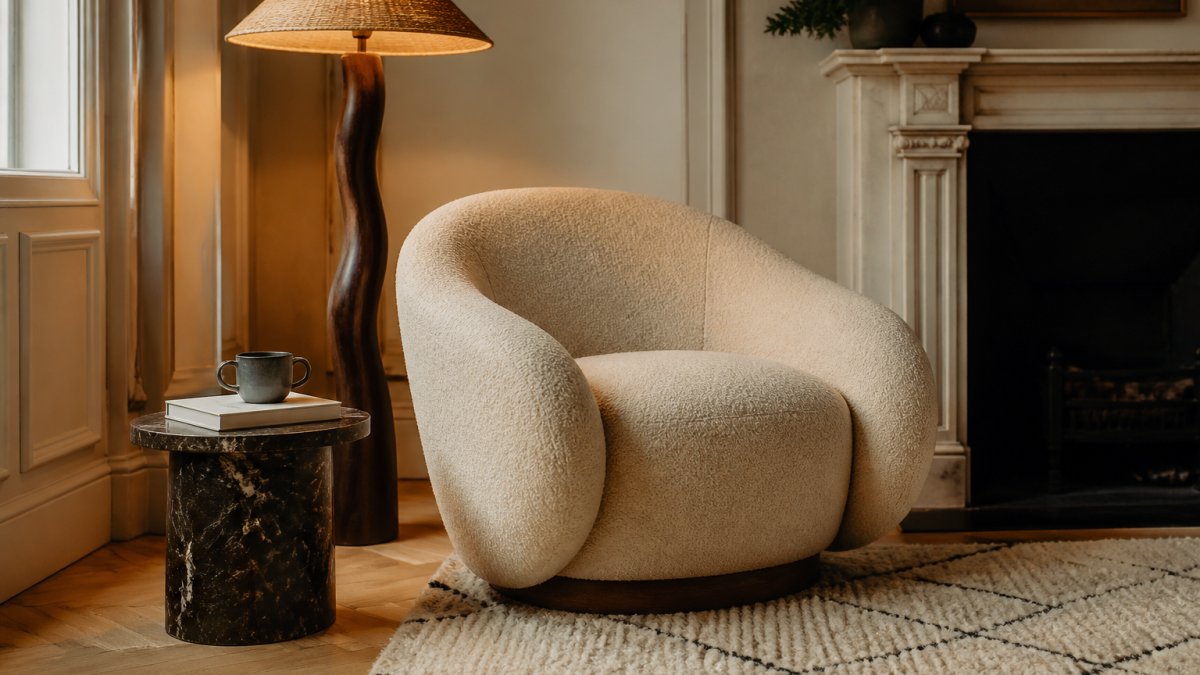
Curved furniture is the trend that has refused to leave, and for good reason. A rounded sofa takes the hard edges off a square room and quietly encourages people to sit closer together. Flowing lines do something a rectangular three-seater cannot: they make a space feel arranged rather than filled.
You don't have to commit to a whole curved suite. Start small. A curved footstool, like the Mini Teal Velvet Curved Bench Footstool, lets you test the shape beside an existing sofa before you spend on the main event. If it works, the curve can grow.
Watch out: curved pieces need more floor space than their width suggests. Measure the full sweep of the arc, not just the front edge, or you'll find the sofa kissing the radiator.
2. Warm neutrals and earthy colours for a calmer scheme
Grey had a good decade. It's now being gently shown the door by warm neutrals: oatmeal, clay, mushroom, and the richer end of the spectrum in earthy greens and deep browns. These are nature-inspired colours, and they age better than any single-season shade because they already look like something that grew.
The practical trick is contrast within the warmth. A cream wall, a camel sofa and a walnut side table all sit in the same family, but they don't blur into one another. Add one darker anchor, a rich brown or a forest green, and the room gains depth without gaining clutter.
Colour-capped walls, where the paint stops short of the ceiling, remain a quiet favourite for period homes with generous ceiling heights. It draws the eye down to the furniture, which is where you want it.
3. Tactile materials: velvet, bouclé and aged wood
Texture is doing the heavy lifting in 2026. Flat finishes photograph well and feel cold in person. Velvet upholstery catches light and changes through the day. Boucle adds a soft, nubbly surface you want to touch before you sit. Aged and reclaimed wood brings grain, knots and a history you can't manufacture.
The Boucle Cotton & Buffalo Leather Armchair is a good example of the approach: a handwoven cotton bouclé body, a buffalo hide leather seat and solid mango wood legs in an oak-ish finish. Three textures, one chair, and none of them shouting.
Watch out: texture only reads when it's next to something plainer. A boucle chair against a boucle sofa against a boucle rug becomes a fog. Give each textured piece a smooth neighbour.
4. Statement pieces and sculptural focal points
Every living room needs one thing the eye lands on first. Sculptural forms do this best, because they're interesting from every angle rather than only head-on.
A round coffee table is the easiest statement to live with. The Mota Wooden Round Coffee Table has a drum-shaped silhouette in burl wood, with swirling grain patterns that make each piece slightly different from the next. It anchors a seating area without blocking the walkway, which a rectangular table of the same size would.

For something with more contrast, the Rany Grey Stone Coffee Table pairs a solid grey stone top with a natural live edge and a twisting antique brass base. Cool stone against warm metal is the kind of small tension that keeps a neutral room from going sleepy.
The one rule: pick your focal point and then be disciplined elsewhere. Two statement pieces in one room start arguing.
5. Made-to-measure living room storage that fits the wall
Made-to-measure living room storage means a piece built to the dimensions of your actual wall, alcove or chimney breast, rather than a standard unit you hope will fit. It's the difference between furniture that looks placed and furniture that looks planned.
Before you fall for anything, measure properly. You need four numbers for every wall: the width at the skirting, the width at picture-rail height, the height floor to ceiling, and the depth from wall to the nearest obstruction.
Then check the route. A unit that fits the alcove but not the stair bend is a costly mistake. Measure your narrowest doorway, the turn on the landing and any tight hallway corner.
Most homes don't need full fitted joinery to get this effect. A well-chosen media unit in the right width does the same job. The Media Unit in solid mango wood with an oak-ish finish measures 90 cm wide, 47 cm high and 35 cm deep, with two drawers and an open shelf, a sensible fit for a chimney breast or a short stretch of wall between a door and a window. Check the internal depth against your actual kit before ordering; a unit that fits the wall but not the router is an expensive lesson.

If the room is tighter, the Mini Curved Media Unit is 60 cm wide and 30 cm deep, with curved edges and four Nordic-style legs. For alcoves where floor space is precious, the Edessa Bone Inlay Cabinet in solid mango wood offers a freestanding alternative with more presence than a fitted box.
Mota Wooden Round Coffee Table | Sculptural | Every Piece is Unique →
For a true made-to-measure piece, the brief matters more than the showroom.
Finally, think about what happens when your needs change. That is the quiet advantage of commissioning: you are buying for the room you have, and the life you actually live in it.
How to commission a handmade furniture maker
It suits anyone who wants something that doesn't exist in a catalogue, a sofa that fits an awkward bay, a media unit sized to the chimney breast, a chair built to a height that suits you.
The process, in order:
-
Write down the brief. Room, wall measurements, what the piece must hold, and how you want it to feel. Vague briefs produce vague quotes.
-
Ask for material samples. See and touch the timber, finish and fabric before you commit. Screens lie about colour.
-
Agree a fixed drawing. Get the final dimensions and design in writing, signed off by both sides.
-
Confirm the deposit and payment schedule. Never pay the full amount upfront. A deposit that covers materials is normal; a request for the full balance before work begins is not.
-
Agree a delivery window in writing, including what happens if the maker runs late.
-
Ask who handles delivery and any assembly, and whether the piece is covered in transit.
Two quotes that look far apart are usually quoting different things, ask each maker to break down materials, labour and delivery so you can compare like with like.
Ask what stage your piece is at, and ask for that in writing at the point of order rather than relying on a verbal estimate.
If you'd rather skip the commissioning process entirely, you can browse our curated collection instead. Each product page lists its dimensions and materials so you can see what you're considering before you commit.
Questions to ask a furniture maker before you commit
Ask these before any money changes hands. The answers tell you more than any showroom ever will.
- What exactly is it made from? Solid timber or veneer? Which species? Is the finish oak-coloured, or is it oak?
- How is it constructed? Joints, fixings and finishes matter more than the sales description.
- What's the realistic lead time, and what's your policy if it slips?
- What does the deposit cover, and when is the balance due?
- What are the care requirements? Ask for them in writing.
- Can I see previous work in person or in detailed photographs?
- What happens if it arrives damaged or doesn't match the agreed drawing?
A maker who answers these plainly is a maker worth waiting for. One who deflects is telling you something too.
Frequently Asked Questions
What counts as bespoke living room furniture?
Bespoke means made to your specification, not chosen from a fixed range. That usually covers dimensions, timber, finish and upholstery, so a piece fits your room rather than the other way round. Made-to-measure sits slightly differently: a standard design adjusted to your measurements, such as a media unit built to a set wall width. Off-the-shelf is the third option, ready in fixed sizes. Knowing which you need shapes both the budget and the lead time.
Is bespoke furniture worth it for a living room?
It earns its place when a standard size will not work: an awkward alcove, a chimney breast, a narrow room where a bulky sofa closes the space down. You also get a say in materials and finish, which matters if you want solid wood rather than veneer. The trade-off is cost and waiting time. If your room is a simple rectangle and a standard piece fits well, off-the-shelf is the sensible choice.
How do I commission a handmade furniture maker?
Start with measurements and photographs of the room, including doorways and any radiator or socket positions. Agree the design, materials and finish in writing, and ask for a drawing or sample before work begins. Confirm the deposit terms, the delivery date and who handles any fitting. Ask how the maker handles natural variation in timber, because grain and colour will differ slightly from any sample you were shown.
What should I ask a furniture maker before commissioning a piece?
Ask what the frame and joints are made from, whether the timber is solid or veneered, and which parts are hand-finished. Confirm lead time in writing and what happens if it slips. Ask about care requirements and whether the piece can be repaired later rather than replaced.
How can I make bespoke living room furniture work in a small room?
Choose fewer, better-proportioned pieces. A low-slung accent chair with an open frame takes up less visual space than a bulky armchair, and a wall-mounted shelf unit frees the floor entirely. Measure the walkway between seating and storage before you order, and keep the palette light so the room reads as larger. Rounded edges help here too: a curved media unit softens a tight corner in a way a sharp rectangle cannot.
The temptation with a living room refresh is to replace everything at once. We'd rather you chose one piece you'll still love in a decade, then built slowly around it. Start with the corner you use most, whether that's a reading chair, a coffee table or the storage that finally swallows the clutter.
Explore the Extraordinary Emporium collection and find the piece your room has been waiting for.
