

Handcrafted Sustainable Dining Tables for Sale: A Buyer's Guide
Last Updated: October 23, 2026
Quick Summary
Handcrafted sustainable dining tables are chosen for longevity first: reclaimed and responsibly sourced timber, solid construction you can sand back and refinish, and joinery built to be used. Ask what the wood is, where it came from and how the piece is joined before you buy.
- Leave 90cm of clear space around the table edge for chair pull-out and walking.
- Solid timber can be sanded and refinished, while engineered wood cannot be refinished the same way.
- Ask for a close-up photo of the actual grain and finish, not the studio shot.
- Oiled tables need re-oiling when water stops beading on the surface.
- A table seating four comfortably and eight at a push is more useful than a single-job piece.
Table of Contents
- Why handcrafted sustainable dining tables earn their place
- How to choose a dining table size for your room
- Dining table materials and finishes worth knowing
- What to check before buying handcrafted sustainable dining tables
- Bespoke dining tables: when made-to-measure makes sense
- How to care for a wooden dining table
- Common mistakes to avoid when choosing a dining table
- Frequently Asked Questions
Why handcrafted sustainable dining tables earn their place
A dining table gets more use than almost any other piece in the home. Breakfasts, homework, work, birthday cakes, the friend who stays for one more cup of tea. Buying one that's built to last is the quietest form of sustainability there is.
That's the case for handcrafted sustainable dining tables for sale: furniture chosen once, kept for decades, and repaired rather than replaced. At Extraordinary Emporium, we select pieces made from reclaimed and responsibly sourced timber, so the grain carries a history before it reaches your dining room.
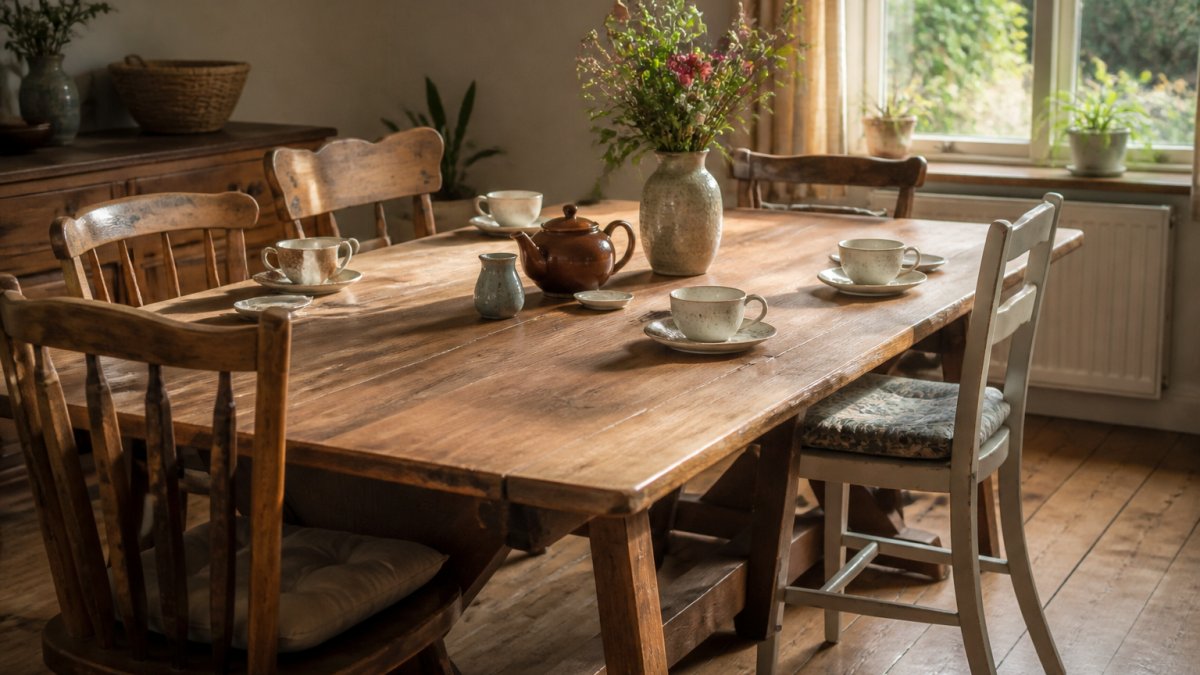
The distinction that matters most is between "sustainable" as a label and sustainability as a material fact. Reclaimed wood, FSC-certified timber and solid construction you can sand back and refinish are verifiable. A green sticker on a flat-pack box is not.
How to choose a dining table size for your room
The right dining table size leaves 90cm of clear space around the table edge for chair pull-out and walking. For a four-seater, allow roughly 60cm of table width per person; for six, plan around 150cm to 180cm in length.
Measure the room, then measure the route to it. A table that fits the dining area but not the hallway is a table that lives in the hallway.
Practical sizing:
- Two people: 70cm to 80cm square
- Four people: 120cm x 80cm
- Six people: 150cm to 180cm x 90cm
- Eight people: 210cm to 240cm x 100cm
Round tables suit small, square rooms because there's no corner to negotiate. Rectangular tables work better in long rooms and against a wall.
Dining table materials and finishes worth knowing
Solid timber is the benchmark for handcrafted sustainable dining tables, because it can be sanded and refinished rather than thrown away. Oak, ash and reclaimed mixed woods are the usual choices, each with a different grain and weight.
Engineered wood is a different proposition. It's stable, smooth and easy to wipe clean, which suits busy households. The trade-off is that it can't be refinished the way solid timber can.
Finishes matter as much as the wood. Hardwax oil sinks into the grain and can be spot-repaired; lacquer sits on top and gives a tougher, more uniform surface. Both are fine. They just ask different things of you later.
Material |
Best for |
Care needs |
|---|---|---|
Solid oak or ash |
Long-term use, refinishing |
Oil or wax yearly |
Reclaimed mixed wood |
Character, one-off pieces |
Gentle cleaning, occasional oil |
Engineered wood |
Easy maintenance, tighter budgets |
Damp cloth, no abrasives |
What to check before buying handcrafted sustainable dining tables
Handmade pieces often arrive flat-packed or partly assembled, and access matters: check doorways, stair turns and lift sizes before you commit.
A short checklist:
- Confirm the exact timber and finish
- Check the assembled dimensions against your doorway
- Check what care products are recommended
Bespoke dining tables: when made-to-measure makes sense
Bespoke dining tables make sense when the room is unusual, the household is large, or nothing standard fits the gap you've measured three times. They cost more and take longer, and they reward patience.
The case against bespoke is simple: if a standard size fits well, buy it. You'll save money and weeks of waiting.
For awkward spaces, a made-to-measure table solves a problem no off-the-shelf piece can. A curved banquette corner, a narrow galley kitchen, a listed building with a beam in the wrong place. That's where commissioning earns its keep.
Our own collection includes a Console Table in mixed recycled wood. For smaller dining spaces, the Artisan Oak engineered wood dining table is a compact 80cm square.

How to care for a wooden dining table
Care for a wooden dining table with a soft, slightly damp cloth for daily spills, a yearly oil or wax treatment, and immediate blotting of anything hot or alcoholic. Never leave water rings to sit.
Heat and moisture do the damage. Use coasters and trivets, wipe spills straight away, and keep the table away from radiators and direct sun where the finish can dry and fade.
Oiled tables need to be re-oiled when water stops beading on the surface. Waxed tables need a thin coat reapplied once or twice a year. Either job takes under an hour and adds years to the piece. Avoid silicone-based polishes and all-purpose sprays can build up on a timber finish and make future repairs difficult. Stick to products that match the finish you have.
Common mistakes to avoid when choosing a dining table
The biggest mistake is buying for the room you have now and forgetting the room you'll have in five years. A table that seats four comfortably and eight at a push is more useful than one that only does one job.
The second is ignoring the chairs. Chair seat height, arm height and table apron depth all interact. A beautiful table with the wrong chairs is an uncomfortable one.
The third is treating "sustainable" as a finish rather than an origin story. The timber, where it came from and the hands that lovingly crafted it.
Frequently Asked Questions
What makes a dining table sustainable?
A sustainable dining table usually means one of two things: reclaimed or responsibly sourced timber, and construction that lasts. Reclaimed wood from fallen trees, old boats or former buildings gives material a second life, while solid construction means the table can be repaired rather than replaced. Ask where the timber came from and how the top is joined. A table you keep for twenty years is the most sustainable option of all, because nothing new has to be made.
How do I choose the right size dining table?
Start with the room, not the table. Leave roughly 90 cm of clear space around the table so chairs can be pulled out without scraping a wall. Allow about 60 cm of table width per person, and 45 cm of depth for place settings. A small dining table of 80 x 80 cm suits two people comfortably. Measure the route from the door to the table too, because a generous table in a tight room quickly becomes an obstacle course.
How can I tell whether a wooden dining table is sustainably sourced?
Check the timber type, where it came from and whether it is reclaimed, reclaimed from boats or buildings, or newly felled. Reclaimed wood often shows signs of wear and slight colour variation, which is a good sign rather than a fault.
How do I care for a solid wood dining table?
Keep it out of direct sun and away from radiators, which dry the timber and encourage splits. Wipe spills promptly with a damp cloth and dry the surface afterwards. Use coasters under hot cups and mats under plates that might scratch. Re-oil or wax oiled finishes once or twice a year, following the maker's instructions. Avoid silicone polishes and harsh cleaners, which can leave a cloudy film. Small marks can often be sanded back gently rather than hidden.
A dining table is the centrepiece of your kitchen, and by extension, your home. It harbours the memories of conversations, arguments, love and occassions. And when choosen well, will be passed on through the generations. Extraordinary Emporium curates handcrafted pieces made from reclaimed and responsibly sourced timber, chosen for character and built for daily life. Browse the dining collection and find the table your room has been waiting for.
