

Signs of High Quality Handcrafted Furniture: A Buyer's Guide
Table of Contents
- How to identify quality wood furniture
- Furniture joinery types that signal real craftsmanship
- How to tell solid wood from veneer
- Questions to ask when buying handcrafted furniture
- Signs of high quality handcrafted furniture in the finish
- Signs of high quality handcrafted furniture in the details
- Conclusion
- Frequently Asked Questions
Last Updated: 21 October 2026
How to identify quality wood furniture
Run your hand along the underside of a table top. If it feels as smooth as the surface above, someone cared. If it feels like a cat's tongue, walk away.
Learning the signs of high quality handcrafted furniture starts with touch, not terminology. A maker who finishes a hidden edge has nothing to hide.
Handcrafted furniture is furniture shaped and assembled by a person rather than a production line, so small variations in grain, joints and finish are expected rather than faults.
Here's what to check first:
- Weight. Solid timber feels heavier than it looks. Hollow board feels light for its size.
- Edges. Sharp, sealed edges suggest care. Rough, splintery ones suggest speed.
- Smell. Real wood smells of wood. Strong chemical smells can mean heavy coatings.
- Stability. Press a corner gently. A well-built piece shouldn't wobble or creak.
The Woodland Trust's guidance on sustainable timber is worth a read if you want to know where your oak or walnut actually came from.
Furniture joinery types that signal real craftsmanship
Dovetail joints are the clearest sign of skilled joinery. Interlocking wedge-shaped pins and tails hold a drawer together without relying on glue alone.
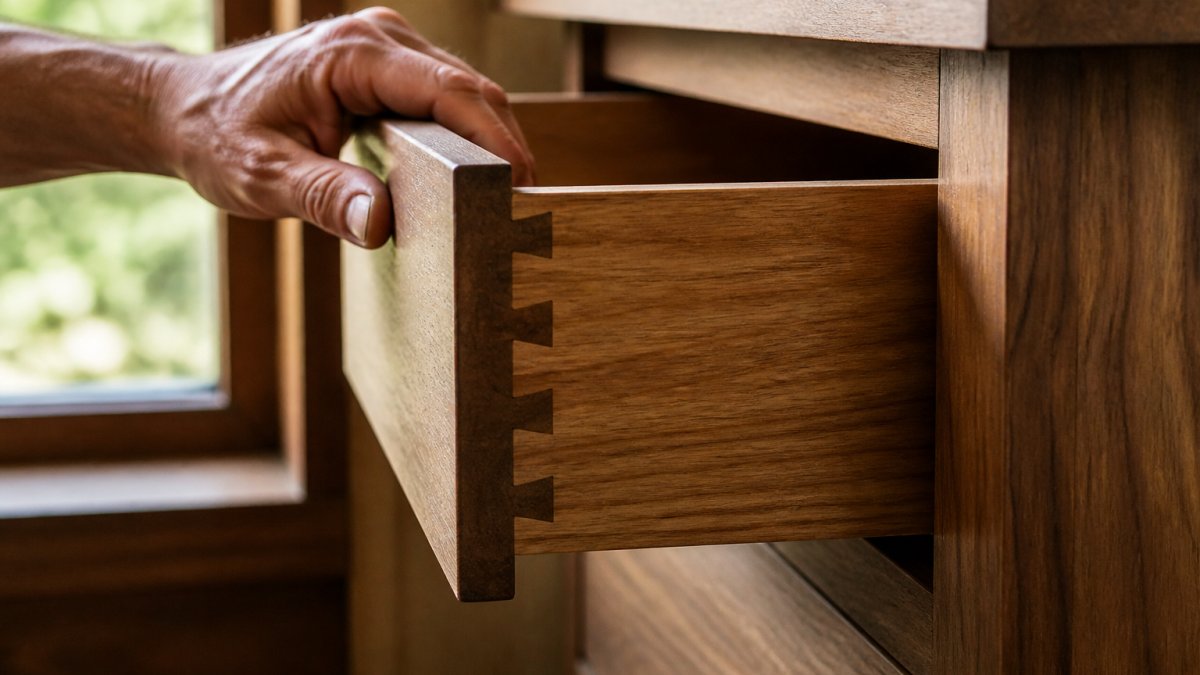
You won't always see them. Drawers often hide their joints behind a front panel. Ask, or look for these alternatives:
- Mortise and tenon: a slot and peg joint, common in chair frames and table legs.
- Finger joints: interlocking square fingers, decent but less refined than dovetails.
- Dowels and screws: fine on their own, weak when they're the only thing holding a drawer box.
- Staples and glue blocks: a sign of fast assembly, not craft.
A common mistake is judging a piece by its drawer fronts alone. Pull the drawer right out and look at the back corners. That's where shortcuts show.
How to tell solid wood from veneer
Solid wood is timber cut from a single piece. Veneer is a thin slice of real wood glued over a core panel, often plywood or MDF.
Veneer isn't a dirty word. Some of the finest furniture uses it, and it's a sensible way to use beautiful timber without waste. The trick is knowing what you're buying.
Try these checks:
- Look at the grain on edges. Solid wood grain continues around the corner. Veneer shows a seam or a different pattern.
- Check repeated patterns. Identical grain on two drawer fronts usually means veneer.
- Look underneath. Solid wood looks the same on the base as on the top.
- Ask directly. A good seller will tell you which parts are solid and which are veneered.
Our Wright oak bedside table is a good example of honesty in this area. It has an oak core and legs with some veneer, and we say so plainly rather than hiding behind the word "oak".

Questions to ask when buying handcrafted furniture
The best buyers ask four questions before they commit. The answers separate a real workshop from a relabelled container.
Ask these:
- Which parts are solid wood, and which are veneered?
- How are the drawers and frames joined?
- What finish is used, and how do I care for it?
- What does the warranty cover, and for how long?
A seller who hesitates on any of these is telling you something. A seller who answers clearly, and puts it in writing, is worth your time.
We list our construction details openly. The Wright oak chest of drawers is solid wood with oak veneers, kiln-dried for strength, and finished with a water-based topcoat that resists water rings and scratches. It comes with a two-year warranty and arrives almost fully assembled.

That's the level of detail you should expect. Not marketing language. Facts you can check.
Wright Oak Chest of Drawers 3 Drawers Hand Crafted Furniture →
Signs of high quality handcrafted furniture in the finish
A good finish protects the wood without hiding it. You should still see the grain, feel the texture and notice the colour shift as light moves across it.
Water-based topcoats are a sensible choice for everyday homes. They guard against rings and scratches without the heavy plastic feel of some older lacquers. On our Wright pieces, that's the finish we specify.
Watch for these finish signals:
- Even colour with no patchy or cloudy areas.
- Grain visible through the coating, not buried under it.
- Smooth, sealed edges on every surface, including the hidden ones.
- No sticky or tacky patches, which suggest a rushed drying process.
- Consistent sheen across the whole piece.
The Furniture Industry Research Association publishes useful guidance on furniture standards and testing if you want to go deeper.
Signs of high quality handcrafted furniture in the details
Details are where handcrafted furniture earns its place. They're also where you'll spot the difference between care and hurry.
Look for:
- Drawers that glide without wobbling or sticking.
- Symmetry in the gaps around doors and drawer fronts.
- Hardware fitted straight, with screws aligned.
- Feet that sit flat on the floor without rocking.
- Consistent grain direction across neighbouring panels.
- A maker's mark or label, if the workshop uses one.
Natural variation is part of the picture. Expect subtle differences in grain, knots and finish. Those small irregularities are the fingerprint of a real piece of timber, not a defect.
Our Wright walnut tallboy shows this well. Solid walnut with walnut veneers, five drawers, and a grain pattern no two pieces share. It's produced in a Sedex ethically audited factory, which is the kind of detail worth asking about when you're buying.
Quick reference: what to check and what it tells you
| What to check | Good sign | Warning sign |
|---|---|---|
| Drawer joints | Dovetail or mortise and tenon | Staples, glue only |
| Edges and undersides | Smooth and sealed | Rough, splintery |
| Grain on edges | Continues around corner | Seam or mismatch |
| Finish | Even, grain visible | Patchy or glassy |
| Drawer action | Smooth, no wobble | Sticks or rattles |
| Weight | Heavy for its size | Light and hollow |
Conclusion
Buying handcrafted furniture asks you to slow down and look properly. Check the joints, the hidden edges and the drawer action. Ask direct questions and expect direct answers.
We curate pieces at Extraordinary Emporium with exactly this in mind. Solid timber, honest construction details, water-based finishes and a two-year warranty across the Wright collection. Explore the Wright oak tallboy or browse the full range to find a piece that earns its place in your home.

Find a piece you'll still be glad to look at in ten years.
Frequently Asked Questions
How can you tell if handcrafted furniture is good quality?
Look at the joints first. Dovetail and mortise-and-tenon joints take time to cut and hold for decades, while staples and screws suggest a quicker build. Check that drawers slide smoothly without wobbling and that the piece feels solid when you press a corner. Run your hand along the underside of a tabletop; a rough, unsanded surface often means the maker cut corners elsewhere. Ask about the finish, too. A water-based topcoat that resists rings and scratches is a practical sign that the piece is built for real life, not just a showroom.
How can you tell solid wood from veneer?
Look at the edges. Solid wood shows end grain that continues the pattern of the face, while veneer often has a thin, uniform edge or a visible seam where the top layer meets the core. Check the grain across a drawer front: on solid wood it wraps around the corner, on veneer it stops flat. Tap the surface lightly. Solid wood sounds dense and consistent, while veneer can sound hollow over a frame. A reputable seller will tell you which parts are solid and which use veneer, so ask directly rather than guessing.
What are the signs of good joinery in furniture?
Good joinery is tight, consistent and designed for the piece's job. Dovetails on drawer corners, mortise-and-tenon joints on frames and dowels or biscuits where panels meet are all signs of a considered build. Run a fingernail along a joint; if it catches on a gap or a ridge of glue, the fit is loose. Open and close every drawer and door. They should move smoothly without binding or rattling. On a chair, press down on the seat and rock it gently. Any creak or flex points to joinery that will loosen with use.
Does handcrafted furniture always mean better quality?
No. Handcrafted describes how a piece is made, not how well. A hand-built piece can still use poor timber or rushed joints. What handcrafting does offer is the chance for a maker to select the wood, fit each joint and finish the surface with care. Your job is to check the evidence: tight joinery, honest materials and a finish that suits the room. Ask what is solid wood and what is veneer, and look for a warranty that backs the build. A two-year warranty on a handcrafted chest of drawers tells you more than the word handcrafted alone.