

Sustainable materials for modern home furniture: a guide
Table of Contents
- Why sustainable materials for modern home furniture matter
- Sustainable furniture materials: a room-by-room primer
- FSC-certified wood furniture: what the label actually tells you
- Sustainable upholstery fabrics that hold up to daily life
- How to identify greenwashing in furniture
- Durability and aesthetics: how sustainable materials age
- A simple framework for choosing sustainable materials
- Conclusion
- Frequently Asked Questions
Last Updated: 18 October 2026
Why sustainable materials for modern home furniture matter
A chest of drawers should outlive the trend that inspired it. That is the quiet case for sustainable materials for modern home furniture: a well-made piece stays in the room, gets repaired rather than replaced, and keeps its character while the flat-pack equivalent quietly sags. At Extraordinary Emporium we select pieces with that longer view in mind, because the most sustainable furniture is usually the furniture you don't need to buy twice.

Sustainable materials are those sourced, processed and finished in ways that limit environmental harm while giving the piece a realistic working life. The material matters. So does the joinery, the finish and whether the timber can be traced.
Below, we'll walk through the materials worth knowing, the labels worth trusting and the questions that separate a genuine claim from a decorative one.
Sustainable furniture materials: a room-by-room primer
Start with the room you use most and work outwards. A bedroom needs solid storage that won't flex; a living room needs tactile surfaces that cope with daily life. The material should follow the job.
Solid wood and reclaimed timber
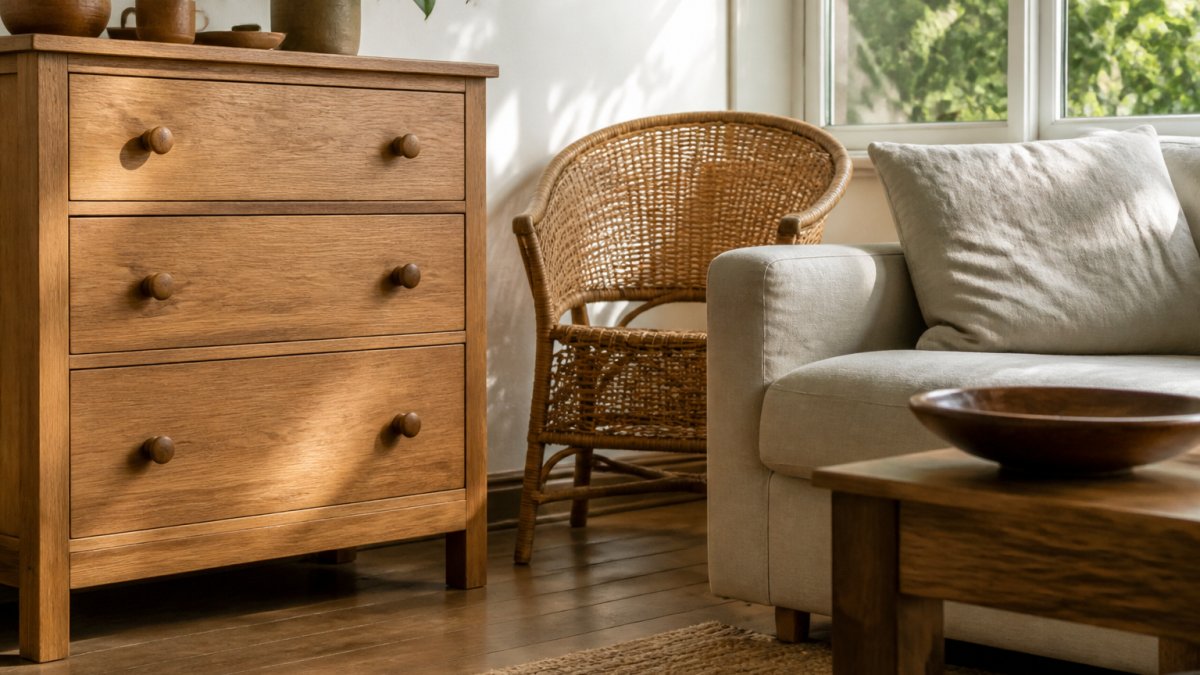
Solid wood is the backbone of durable furniture. Look for kiln-dried timber, which is dried to a controlled moisture level for stability, and check whether the piece is solid throughout or built with veneers over a manufactured core. Both have their place; the honest description is what matters.
Reclaimed timber brings its own history: old nail marks, filled knots, a grain that has already settled. Expect variation, and treat it as part of the piece rather than a defect.
Bamboo, rattan and other fast-growing options
Bamboo and rattan grow quickly and suit lighter pieces: chairs, shelving, decorative storage. They are not automatically the greener choice, since processing and transport still count. Ask how the material was finished and whether the frame is built to be sat on rather than merely admired.
FSC-certified wood furniture: what the label actually tells you
FSC-certified wood furniture carries a chain-of-custody claim: the timber can be traced from forest to finished piece. The Forest Stewardship Council's guidance on what certification covers explains the difference between full certification and mixed-source labels, and it's worth reading before you assume every logo means the same thing.
A certificate is a starting point, not a finish line. Ask which parts of the piece are certified, whether the veneer and drawer bases are included, and how the finish was applied. A water-based topcoat, for instance, is a practical detail you can verify and a reasonable thing to ask about.
Sustainable upholstery fabrics that hold up to daily life
Fabric choice is where good intentions meet real life. Linen softens and creases; wool resists dirt and recovers its shape; cotton blends are easy to clean. None of these is invincible, and a tightly woven upholstery-weight cloth will always outlast a loose decorative weave.
Check the rub count if it's quoted, ask whether covers are removable, and confirm what the frame is made from. A sustainable upholstery fabric on a weak frame is a short-lived sofa with good paperwork.
How to identify greenwashing in furniture
Greenwashing in furniture usually appears as an adjective with nothing behind it. "Eco-friendly" and "planet-saving" mean little on their own. Specific, checkable statements mean a great deal.
The Competition and Markets Authority's guidance on environmental claims sets out the standard businesses are expected to meet, and it gives you a useful test: is the claim specific, and could it be substantiated if challenged?
- Vague superlatives with no material or process named
- A certification logo with no certificate number or scope
- "Sustainable" applied to a whole range when only one component qualifies
- No information on finish, packaging or where the piece was made
Durability and aesthetics: how sustainable materials age
Good materials improve with use. Oak develops a deeper tone and takes on the odd mark as patina. Walnut darkens gently. Rattan softens where hands rest. Linen creases into something more relaxed than it was on day one.
Wright Oak Chest of Drawers 3 Drawers Hand Crafted Furniture →
This is the aesthetic argument for choosing carefully: a piece that ages well looks better in year five than it did in week one. The Woodland Trust's resources on British timber and woodland management is a useful starting point if you want to understand where timber comes from and why species choice matters.
Our Wright Oak Chest of Drawers is a fair illustration of the principle: solid wood with oak veneers, kiln-dried for stability, finished with a water-based topcoat to guard against water rings and scratches, and covered by a two-year warranty. It comes with a tipping-hazard warning and must be fixed to the wall using the enclosed safety fitting.
A simple framework for choosing sustainable materials
Use this as a shortlist rather than a rulebook. Score each piece against the four questions and you'll quickly see which ones deserve a second look.
| Question | What to look for | Why it matters |
|---|---|---|
| What is it made of? | Named species, solid wood or veneer stated plainly | You can't judge a material that isn't named |
| Where did it come from? | Certification number, factory audit, country of origin | Traceability is the foundation of any claim |
| How is it finished? | Water-based topcoat, non-toxic colour, care instructions | Finish affects indoor air and daily upkeep |
| Will it last and be repaired? | Joinery, warranty terms, replaceable parts | Longevity is the strongest sustainability argument |
The Oslo Chest of Drawers, made from sustainably sourced mango wood with no veneers and a non-toxic water-based finish, is the kind of piece that answers all four questions without prompting.
Conclusion
The challenge is rarely finding a sustainable material; it's finding a piece you'll keep. Start with the material, verify the claim, and buy for the room you actually live in.
Extraordinary Emporium selects artisan handcrafted furniture with exactly that in mind: solid construction, honest materials and pieces that bring personality to a home rather than filling a gap. Explore the bedroom collection to see how solid wood and considered finishes work in practice.
Frequently Asked Questions
What materials are most sustainable for furniture?
Solid wood from certified or reclaimed sources, fast-growing materials such as bamboo and rattan, and natural upholstery fabrics like linen and wool are among the most sustainable choices. The key is how the material is sourced and how long it will last. A piece made from FSC-certified oak that stays in your home for decades will usually have a lower impact than a cheaper item replaced every few years. Look for specific claims, not vague green language.
Is reclaimed wood a sustainable choice for furniture?
Yes, reclaimed wood is generally a strong choice because it diverts timber from waste and avoids new logging. It often has more character too, with visible knots and a patina you won't find in new timber. The main things to check are how it has been treated and whether any finish is safe for indoor use. Ask the seller where the wood came from and what has been applied to it.
How can I tell whether furniture materials are sustainably sourced?
Look for specific, verifiable claims rather than broad words like eco-friendly. FSC-certified wood furniture should carry a chain-of-custody reference you can check. For upholstery, ask about the fibre content and any certifications. A reputable seller will answer questions about where materials come from and how the piece was made. If the response is vague or defensive, treat that as a warning sign.
Is bamboo more sustainable than solid wood for furniture?
Bamboo grows quickly and can be harvested without replanting, which gives it an advantage on paper. Solid wood from a certified, well-managed forest is also a strong option, especially when the piece is built to last. The comparison depends on the specific product: a bamboo item glued together with heavy resins may be less durable than a solid oak chest. Judge the finished piece, not just the raw material.
What should I look for in sustainable upholstery?
Start with natural fibres such as linen, wool or cotton, and ask about how they were produced. Check whether the fabric is durable enough for the way you use the room, since longevity is part of sustainability. Look for specific certifications or details about dyeing and finishing. Avoid fabrics described only as green or eco without any supporting information about fibre, origin or process.
How can I avoid greenwashing when buying furniture?
Ask for specifics: which forest, which factory, which certification. Vague terms like planet-friendly or guilt-free mean little without evidence. Check whether claims are backed by recognised schemes such as FSC for wood. Be wary of a single green phrase used to sell an otherwise ordinary product. A seller who can explain the material and the making process clearly is usually a safer bet.
Does buying second-hand furniture help reduce environmental impact?
Yes, keeping existing furniture in use avoids the resources needed to make something new. A well-made second-hand piece can be reupholstered or refinished and last for many more years. The same principle applies to new furniture: choose pieces you will want to keep. Buying less, and buying better, is often the most effective approach.
Choosing furniture that lasts means asking better questions before you buy, not after. Extraordinary Emporium curates artisan handcrafted pieces with traceable materials, considered finishes and everyday practicality built in. Browse the collections and find something worth keeping.