

7 Ways to Spot Greenwashing in Furniture
Last Updated: 25 October 2026
Quick Summary
Spotting greenwashing in furniture means reading the material line slowly and asking for documents that exist outside the marketing copy. Vague terms like eco-friendly and natural are not regulated on a furniture swing tag, so ask which certification the timber carries and check the licence number against the scheme's own database.
- Read the material line as separate facts: species, solid or veneered, and where each applies.
- A certificate shown for one product does not cover the rest of the range.
- FSC and PEFC speak to where the wood came from; Sedex speaks to how the factory operates.
- Ask which certification rather than is this sustainable, and you'll get a number or a shuffle.
- A chest that lasts thirty years needs replacing once; a cheap one that sags in three needs replacing ten times.
Table of Contents
- Why greenwashing in furniture is so hard to spot
- Greenwashing examples in furniture you'll recognise
- How to check furniture sustainability claims before you buy
- Furniture eco labels: which ones carry weight
- Questions to ask when buying sustainable furniture
- The quiet test: does the piece look like it will last?
- Browse the collection with clearer eyes
- Frequently Asked Questions
Why greenwashing in furniture is so hard to spot
Greenwashing in furniture is the practice of making a piece sound more sustainable than it is, usually through vague wording, leafy imagery or a claim that cannot be checked. It works because most of us buy furniture rarely. You might choose a sofa once a decade, so you never build the pattern recognition that makes a misleading label obvious.
The vocabulary does a lot of the hiding. "Eco-friendly", "natural" and "planet-conscious" are not regulated terms on a furniture swing tag. A pine frame can be called natural. So can a lacquered MDF shelf.
Then there is the supply chain itself. A chest of drawers may involve timber from one country, veneer from another, hardware from a third and assembly somewhere else entirely. Untangling that from a showroom label is genuinely difficult, which is exactly why the vague claim survives.
At Extraordinary Emporium, we read a lot of supplier paperwork. The pattern is consistent: the pieces that shout loudest about sustainability tend to say the least about materials. Below, we'll show you the specific claims to slow down on, the questions that get a straight answer, and the labels worth trusting.
Greenwashing examples in furniture you'll recognise
Some greenwashing examples in furniture are almost comically easy to catch once you know the shape of them. Four turn up again and again.
- The leaf motif. A green background and a fern illustration on a product page, with no material detail anywhere near it.
- "Eco-friendly" as a standalone claim. No material named, no process named, no way to check it.
- "Sustainable wood" with no species. Which wood? Grown where? Certified by whom?
- The recycled badge with no number. "Made from recycled materials" tells you nothing about how much, or which parts.
Here's the one that catches careful buyers: a solid oak frame with an oak-veneered back panel, described simply as "oak". The timber is real. The description is still doing some quiet editing.
None of these are necessarily lies. That's what makes them effective. They're claims loose enough to be technically true and vague enough to be useless.
How to check furniture sustainability claims before you buy
Checking furniture sustainability claims comes down to two habits: reading the material line slowly, and asking for documents that exist outside the marketing copy. Neither takes long. Both separate the considered pieces from the decorated ones.
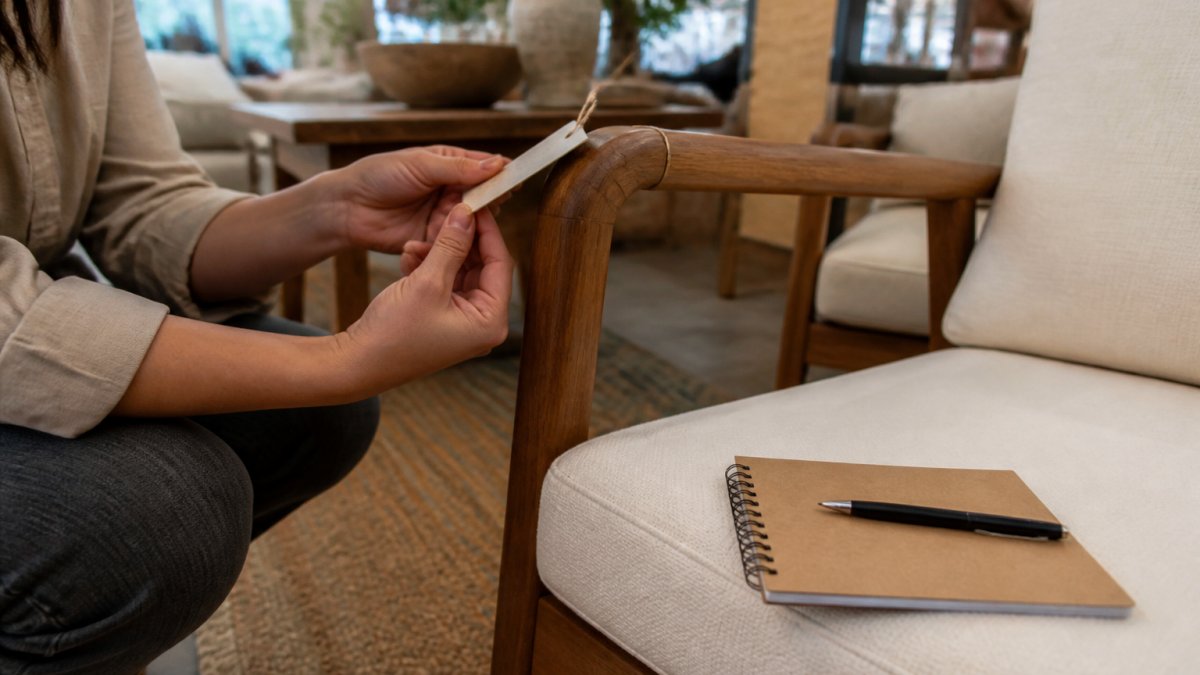
Read the material description line by line
Take the material line and read it as a list of separate facts, not a mood. A good description tells you the species, whether it's solid or veneered, and where each applies.
Watch for these distinctions in particular:
- Solid wood versus veneer. Both have their place. Only one is what most people picture.
- Oak-coloured finish versus oak timber. A colour name is not a species.
- Contact leather versus all-over leather. Different amounts of the real thing.
- "Wood-effect" means it isn't wood.
If the material line is shorter than the delivery information, that tells you something. For a fuller guide to what sustainable materials actually are and how to recognise them, our piece on sustainable materials for modern home furniture breaks the categories down.
Ask for the paper trail
Ask a direct question and see what comes back. "Can you tell me which certification the timber carries, and who audited the factory?" A retailer working with documented suppliers will answer. A retailer working with adjectives will change the subject.
Watch out: a certificate shown for one product does not cover the rest of the range. Ask for the paperwork that matches the piece in front of you.
Furniture eco labels: which ones carry weight
Furniture eco labels split into two groups: schemes that audit a supply chain and check a specific claim, and logos that mean very little. The second group is larger.
The ones worth looking up:
Wright Oak Chest of Drawers 3 Drawers Hand Crafted Furniture →
- FSC (Forest Stewardship Council). Certifies that timber comes from responsibly managed forests. Check the licence code on the label against the FSC database rather than trusting the logo alone, as set out by the Forest Stewardship Council.
- PEFC (Programme for the Endorsement of Forest Certification). A separate forest certification scheme with its own chain-of-custody standard.
- Sedex. A membership organisation for supply chain audits covering labour, ethics, health and safety and environment. A Sedex-audited factory means the site has been assessed, not that the timber is certified.
The distinction that matters: FSC and PEFC speak to where the wood came from. Sedex speaks to how the factory operates. A piece can carry one and not the other, and a good supplier will tell you which.
A logo with no membership number, no scheme name and no way to search it is decoration. Treat it as such.
Three schemes are worth looking up, and each one tells you something different.
| Label | What it covers | What to check |
|---|---|---|
| FSC (Forest Stewardship Council) | Timber from responsibly managed forests | Licence code against the FSC database |
| PEFC (Programme for the Endorsement of Forest Certification) | Forest certification with its own chain-of-custody standard | Its own chain-of-custody standard |
| Sedex | Supply chain audits: labour, ethics, health and safety, environment | Site has been assessed, not that timber is certified |
Questions to ask when buying sustainable furniture
The quickest way to sort a real claim from a decorative one is to ask questions a vague answer cannot survive. These are the questions we would put to any supplier, and the ones to ask when buying sustainable furniture yourself.
- Which wood species is this, and is any part of it veneered?
- Which certification does the timber carry, and what is the licence number?
- Who audited the factory, and when was the last audit?
- What finish is on the surface, and is it water-based?
- Which parts are recycled, and roughly what proportion?
- Can you send the material and sourcing documentation before I order?
Two things to listen for. First, whether the answer names a specific document or a specific scheme. Second, whether the answer arrives quickly. Suppliers who know their chain don't need to check.
A common mistake is asking "is this sustainable?" That question invites a yes. Ask "which certification?" and you'll get either a number or a shuffle.
The quiet test: does the piece look like it will last?
The most reliable sustainability claim in furniture is durability. A chest that lasts thirty years needs replacing once. A cheap one that sags in three needs replacing ten times, and no label changes that arithmetic.
Look at the finish, too. To tell honest making from marketing language, learn to recognise the signs of genuine artisan craftsmanship. A water-based topcoat that resists water rings and scratches keeps a surface out of the skip for longer. And check the small print: a piece sold with a stated warranty period is a piece the seller expects to survive. If you want concrete signs to look for, our guide to signs of high quality handcrafted furniture sets them out.
Browse the collection with clearer eyes
You now have a working filter. Read the material line slowly. Ask for the certification number. Check the joinery. Ignore the leaves.
None of that requires expertise, just a little patience at the point of purchase. And it changes what you notice. A piece that names its timber, its finish and its factory audit starts to feel different from one wrapped in adjectives.
That's the standard we work to when selecting for Extraordinary Emporium. The Wright oak chest of drawers is a useful place to test the filter: solid wood with oak veneers, a water-based topcoat, a Sedex-audited factory and a stated warranty, all listed where you can read them. Browse the collection with the checklist in hand and see what survives it.

Frequently Asked Questions
What does greenwashing mean when buying furniture?
Greenwashing is when a brand makes environmental or ethical claims that sound better than the reality. In furniture it often shows up as vague words like eco-friendly, sustainable or planet-positive with nothing specific behind them. A genuinely responsible piece will tell you the material, where the timber came from, how it was finished and who made it. If a product page leans on feeling rather than facts, treat that as your first clue that greenwashing in furniture may be at work.
How can I check whether wood furniture is responsibly sourced?
Start with the specification. Solid wood should be named as a species, such as oak or walnut, rather than described as wood-effect or oak-coloured. Ask whether the timber is certified and by which scheme, and whether the factory holds a social audit such as Sedex. A retailer that can answer these questions plainly is showing you its working. The Wright Oak Chest of Drawers, for example, lists solid wood with oak veneers, kiln-dried timber and production in a Sedex ethically audited factory, which gives you something concrete to weigh up.
Are eco labels on furniture reliable?
Some are, and some are marketing badges invented by the brand itself. Genuine furniture eco labels come from independent bodies and can be checked on the certifier's own register, so look for a scheme name you can search and a certificate number you can verify. A logo with no scheme name, no number and no link to a certifier is decoration, not proof. If a label cannot be traced back to the organisation that issued it, set it aside and rely on the material specification instead.
What should I ask a furniture retailer about materials and sourcing?
Ask four things. What is the piece actually made of, including any veneer or finish? Where was the timber grown or the material sourced? Who made it, and can the retailer describe the factory or workshop? And what happens if it fails within a few years? A straight answer to all four is more persuasive than any badge. Vague replies, or a redirect to a sustainability page full of slogans, tell you plenty about how much substance sits behind the claims.
The real challenge isn't finding furniture that looks sustainable. It's finding pieces whose claims you can actually check, and that will still be in your home long after the trend has moved on. Extraordinary Emporium curates handcrafted pieces with the details stated plainly: solid wood construction, kiln-dried timber for strength, water-based finishes, and factory audits you can ask about. Get started with Extraordinary Emporium and furnish a room you won't want to replace.
